China Best Spotlight vs Floodlight What Is the Difference?

Time:2026-11-18 Author:Ethan
0%

Choosing between a spotlight and a floodlight starts with the beam, not the product name. A spotlight concentrates light into a narrower area, making it useful for highlighting a doorway, sign, tree, or architectural detail. A floodlight spreads light across a wider space, such as a driveway or loading area. The practical question is: what is the difference between spotlight and floodlight when both products may look nearly identical on a supplier’s website? Check the beam angle, lumen output, mounting height, and intended coverage. Labels alone can be vague.

Energy use matters, too, but beam type does not determine efficiency by itself. The U.S. Department of Energy reports that LED lighting uses at least 75% less energy and can last up to 25 times longer than incandescent lighting. That comparison concerns LED technology, not spotlights versus floodlights, so compare wattage and measured light output when evaluating specific models. For commercial specifications, the Illuminating Engineering Society’s guidance offers a useful framework for assessing lighting needs and application conditions. In China’s broad lighting market, product specifications and quality can vary, so ask manufacturers for photometric data rather than relying only on marketing claims. Details matter. A narrow beam can create harsh bright spots; a broad one may spill light where it is not needed. The choice is not always tidy. Start with the area you need to illuminate, then compare verified specifications and installation conditions.
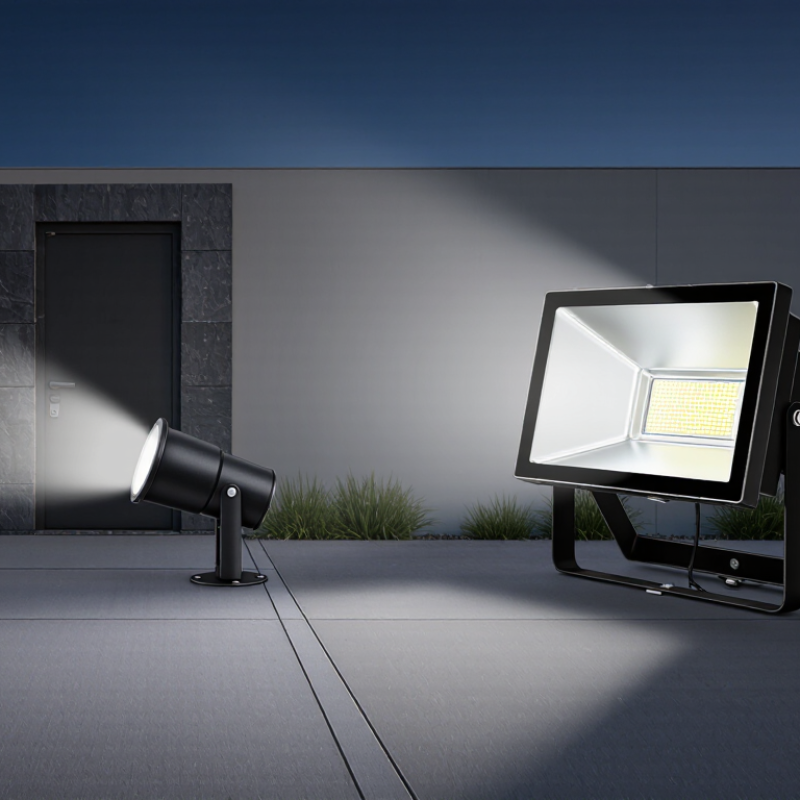
China Best Spotlight vs Floodlight What Is the Difference?

What Are Spotlights and Floodlights?

Spotlights and floodlights are both electric lights, but they shape light differently. A spotlight sends a relatively narrow beam toward a defined area, such as a doorway, sculpture, or workbench. Its focused pool can make one object stand out while leaving nearby walls dimmer. A floodlight spreads a wider beam across a larger area, such as a driveway, garden path, or building frontage. The transition is usually softer, though beam shape and brightness vary by fixture.

That difference matters.

Choosing between them starts with the task, not just the label. Check the beam angle, mounting height, light output, and distance to the target; a powerful fixture can still leave dark patches if aimed poorly. For a small sign, a spotlight may provide useful contrast. For broad coverage, a floodlight is often more practical.

Yet neither category guarantees a particular result. Lens design, surface color, and nearby obstructions all affect what you see.

Not always, though.

Check the area after dusk and adjust the aim. A bright circle on the ground may look effective in daylight, then reveal glare or uneven coverage at night. Fixed aiming can also be less forgiving than expected.

How Do Their Beam Patterns and Coverage Differ?

A spotlight sends light into a relatively narrow, concentrated beam. Its bright center can reach farther, making details stand out across a driveway or at the end of a garden path. The beam often has a noticeable edge. That edge may look harsh on a wall, especially when the light is aimed from a low position.

A floodlight spreads light over a wider area, with softer transitions between bright and dim zones. It can cover a garage entrance, patio, or broad section of yard with fewer dark gaps. The trade-off is reduced intensity at any single point. Wide does not always mean even: fences, trees, and changes in mounting height can still create shadows.

Beam angle is a useful comparison, but it does not tell the whole story. Two lights with similar angles may cover different areas because their output, optics, and distance vary. For a practical check, stand where the light will be mounted and mark the intended coverage on the ground. A narrow beam may need careful aiming. A floodlight can spill onto nearby windows or leave the far edge dim. The distinction is useful, but real spaces rarely fit a perfect diagram.

Where Are Spotlights and Floodlights Commonly Used?

Spotlights are commonly used when one feature needs attention. A narrow beam can pick out a garden tree, stone wall, entrance sign, or building detail without lighting the whole area. In a yard, place the fixture low and aim it upward to reveal bark and leaves. On a path, a focused beam can highlight a doorway or step. It is precise. But aim matters: a beam pointed toward a neighbor’s window can cause glare, and a tree changes shape as it grows.

Floodlights suit broader spaces. They are often installed above garage doors, along building walls, in loading areas, and over driveways or sports courts. Their wider spread helps people see obstacles across a larger area, such as a parked car and the path beside it. Still, wider does not always mean better. A fixture mounted too high or aimed carelessly may spill light into bedrooms or wash out useful detail. Choose beam spread and brightness for the actual distance and area, and check that the fixture is rated for its exposure to rain. I’d test the angle at night; daytime aiming can be misleading.

Spotlight vs. Floodlight: Typical Beam Angles

Spotlights use a narrower beam to concentrate light on specific features or distant targets. Floodlights spread light over wider areas, making them useful for building facades, yards, and general outdoor illumination. The chart shows representative beam-angle ranges; actual angles vary by fixture and optics.

What Factors Matter When Choosing Between Them?

Choosing between a spotlight and a floodlight starts with the area you need to illuminate. A spotlight produces a narrow beam for a gate, sign, or tree trunk. A floodlight spreads light across a driveway or work area. Check beam angle, mounting height, and distance together. A narrow beam mounted too high can leave a bright patch and dark edges. That happens more often than expected.

Brightness alone is a poor guide. Compare lumens, beam distribution, and illuminance at the target surface. For example, a 2,000-lumen spotlight may look intense, yet cover less ground than a lower-output floodlight. The International Energy Agency’s Energy Efficiency 2023 report notes that lighting represents about 15% of global electricity use. Efficient LEDs help, but choosing excess output still wastes energy and can create glare. I would check a photometric layout before buying for a large site. It takes extra effort.

Also consider weather exposure, color rendering, and controls. A motion sensor suits a side entrance, while a steady floodlight may work better for regular outdoor tasks. The Illuminating Engineering Society’s TM-15 method classifies outdoor-light distribution using backlight, uplight, and glare ratings. Those ratings help compare spill and visual comfort, not just brightness. For a small yard, a wide beam may feel harsh near windows. I have seen this overlooked. Test the fixture’s aim after dark, then adjust it toward the task rather than neighboring homes.

How Do Chinese Lighting Manufacturers Compare These Options?

When comparing Chinese lighting manufacturers, judge the beam before the brochure. A spotlight concentrates light on a sign, doorway, or display; a floodlight spreads it across a wall, yard, or work area. Ask suppliers for photometric files and an IES LM-79 test report showing measured lumens, wattage, and beam distribution. The U.S. Department of Energy’s LM-79 method measures complete LED products, making supplier results easier to compare. IEA estimates lighting uses about 15% of global electricity, so efficacy matters too; compare lumens per watt, not wattage alone.

Request matching samples in the same color temperature and mounting position. A narrow beam can create sharp glare on a glossy floor, while a broad beam may leave a distant corner dim. Compare driver details, ingress-protection ratings, warranty terms, and stated operating temperatures. These reveal how manufacturers handle real installation conditions, not just laboratory claims. One limitation: a report cannot show every site’s shadows or surface reflections. I would still test a sample; specifications can look convincing and disappoint on site.

Tips: Ask for the same test documents from every supplier. Confirm whether quoted lumens are measured at the fixture or estimated from the LED chips. For outdoor use, check the declared ingress-protection rating and verify it suits your exposure conditions.

China Best Spotlight vs Floodlight: What Is the Difference? How Do Chinese Lighting Manufacturers Compare These Options?

Comparison Dimension Spotlight Floodlight How to Compare Manufacturer Options
Primary purpose Directs light onto a defined area or object, such as a display, sign, architectural feature, or stage subject. Spreads light over a wider area, such as a yard, building façade, work zone, or sports area. Start with the target: a specific object or accent usually calls for a spotlight; broad area coverage usually calls for a floodlight.
Beam distribution Usually has a narrower, more concentrated beam. Available beam angles vary by product and optics. Usually has a wider beam distribution designed to cover a larger area. Compare the photometric distribution or IES file, not just labels such as “spot” or “flood.” Beam-angle definitions can differ between suppliers.
Typical beam-angle ranges Often offered with narrow and medium optics; a practical range may be approximately 10°–40°, depending on the product. Often offered with wider optics; a practical range may be approximately 60°–120°, depending on the product. Treat these ranges as examples, not fixed standards. Request the actual beam-angle specification and distribution data for the exact model.
Light distribution Concentrates light into a smaller area and can create stronger contrast between the illuminated subject and its surroundings. Distributes light more broadly, which can improve general visibility across an open area. Check for beam uniformity, spill light, glare, and dark patches using photometric files or a project-specific lighting calculation.
Illuminance at the target Can provide higher illuminance on a small target when correctly aimed, but the result depends on output, beam shape, and distance. Can cover a larger area, but illuminance varies across that area and generally decreases as mounting distance increases. Compare delivered lux at the required distance and area. Wattage alone does not show how much light reaches the target.
Common applications Retail displays, landscape accents, artwork, signage, façade details, and stage or studio highlighting. Building exteriors, parking areas, loading zones, construction sites, yards, and other broad outdoor spaces. Ask the supplier to confirm that the proposed optics and mounting arrangement suit the application and installation height.
Glare and spill-light control A narrow beam can reduce unwanted spill when aimed carefully, but it may cause glare if the source is visible or poorly positioned. A wide beam can spill beyond the intended area and may cause glare if installed too high, aimed incorrectly, or left unshielded. Compare shielding, cutoff options, aiming accessories, and glare-control data. For outdoor projects, also review local requirements for light trespass.
Aiming and installation Often needs precise aiming to place the beam on a specific subject or feature. Usually aimed to cover a broader zone; mounting height and spacing affect coverage and uniformity. Review bracket adjustment, mounting details, installation instructions, and any aiming plan before choosing a model.
Energy use and efficiency Efficiency depends on the LED, driver, optics, thermal design, and operating conditions; a narrow beam is not automatically more efficient. Efficiency also depends on the complete fixture and how well its distribution matches the area being lit. Compare measured luminaire efficacy in lumens per watt alongside useful light distribution, input power, and the required lighting result.
Weather protection Indoor and outdoor versions are available; outdoor suitability depends on the fixture’s specified ingress-protection rating and installation conditions. Many models are designed for outdoor use, but weather resistance still depends on the exact rating and construction. Check the stated IP rating for the complete fixture and confirm that it matches the project’s exposure to dust and water. Do not assume all models are outdoor-rated.
Useful technical documents For either type, relevant documents may include a datasheet, photometric report or IES file, electrical specifications, installation instructions, and applicable test or conformity documents. Compare documents for the exact model and configuration being quoted. Verify that electrical, optical, and protection specifications are clearly stated.
Sample evaluation A sample can help assess color appearance, beam shape, glare, housing finish, aiming, and fit with the intended installation. Test samples under representative conditions, using the intended mounting position and viewing angles. Confirm that production specifications match the approved sample.
Best selection approach Choose when controlled, directional illumination of a defined subject or area is the priority. Choose when wider coverage of an open space is the priority. Compare beam distribution, delivered light, glare control, environmental rating, documentation, and sample performance—not product category or price alone.

FAQS

What is the main difference between a spotlight and a floodlight?

A spotlight sends a narrow beam toward one target. A floodlight spreads light across a wider area. One highlights details; the other covers space.

Where does a spotlight work well?

Use one for a gate, sign, tree trunk, or workbench. Its focused beam can reach farther. Aim carefully.

When is a floodlight more practical?

A floodlight can cover a driveway, patio, or garage entrance. It may reduce dark gaps, though fences and trees can still cast shadows.

Does a wider beam guarantee even coverage?

No. Mounting height, obstacles, and distance all affect the result. Wide does not always mean even.

What should I check before choosing a light?

Check beam angle, mounting height, and distance to the target. Consider output and beam distribution too. A bright fixture can still leave dark edges.

Is brightness alone enough to compare lights?

No. Compare lumens with how the beam spreads and the light reaching the target surface. A high-output spotlight may cover less ground than a lower-output floodlight.

How can I avoid glare and spill?

Test the aim after dark. Point the light toward the task, not nearby windows. It is easy to miss a bright patch from indoors.

Are motion sensors useful outdoors?

A motion sensor can suit a side entrance. Steady lighting may work better for regular tasks. I might be overthinking the choice, but test the setup first.

Conclusion

Spotlights and floodlights are both used to illuminate spaces, but they serve different purposes. A spotlight produces a narrow, concentrated beam that highlights a specific object or area, while a floodlight spreads a wider beam to provide broad, even coverage. Understanding what is the difference between spotlight and floodlight can help you choose suitable lighting for homes, gardens, workplaces, events, and outdoor areas. The best option depends on the size of the space, the distance to the target, the desired brightness, and whether focused emphasis or general visibility is more important.

When comparing products, consider beam angle, light output, color temperature, energy use, durability, and installation needs. Chinese lighting manufacturers may offer both spotlight and floodlight options in a range of specifications, materials, and configurations. Rather than choosing by product type alone, compare technical details and intended applications to find a solution that fits your project, provides appropriate coverage, and performs reliably in its operating environment.

Ethan

Ethan

Ethan is a seasoned marketing professional with a deep expertise in our company's innovative product line. With a passion for sharing knowledge and insights, he takes the lead in regularly updating our corporate blog, where he explores industry trends, product features, and effective marketing......