Why are my LED bulbs flickering when turned off? The faint pulse in a dark hallway can feel like a wiring fault, but it often has a simpler cause. Some LED bulbs glow or flash when a small current continues through the circuit. Lighted wall switches, electronic dimmers, and induced current between nearby wires can all contribute. The bulb is off, but its driver may still receive enough energy to flash briefly.
The U.S. Department of Energy’s Pacific Northwest National Laboratory has studied flicker and LED lighting performance, while IEEE Recommended Practice 1789-2015 sets guidance for reducing flicker from LED sources. These resources show why the driver and control system matter, not just the bulb itself. PNNL lighting researcher Michael Poplawski’s published work offers a practical reminder: LED behavior depends on how the lamp’s driver interacts with the control circuit. That compatibility is easy to overlook.
Look closely. Does the bulb flash once, pulse every few seconds, or glow steadily? Each pattern can point toward a different cause. A compatible dimmer or a different bulb may solve the problem, but guessing is not always wise. I have seen small lighting quirks dismissed too quickly; persistent flickering deserves a closer check, especially if other lights behave strangely or a switch feels warm. This guide explains likely causes, safe first checks, and when to call a qualified electrician. Not every flicker means danger. But it should not be ignored.
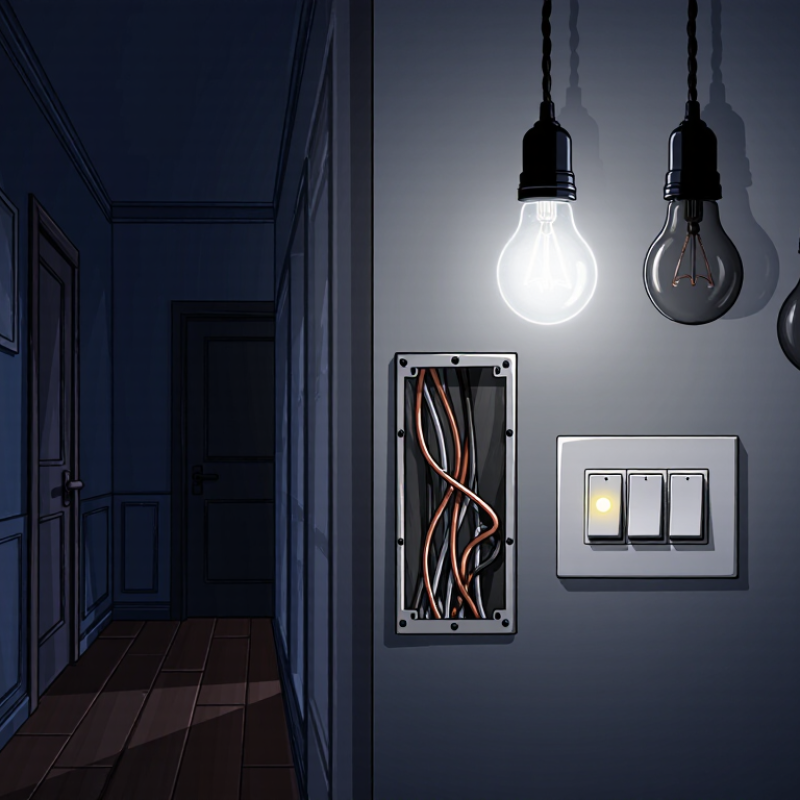
With the wall switch off, an LED bulb may still give a faint, steady glow. It can look like a thin outline around the diffuser, or a small pool of light in an otherwise dark room. Sometimes the glow is visible only after your eyes adjust. It is easy to mistake it for light leaking in from a hallway.
Other bulbs blink briefly, then remain dark for several seconds or minutes. Some flash once when the switch is flipped off. Others pulse at uneven intervals, like a weak heartbeat. The pattern is not always tidy. Two bulbs on the same circuit may behave differently, and a phone camera can make a faint glow look stronger than it appears in person.
These observations describe the symptom, not its exact cause. A lighted switch, dimmer, or small current passing through the circuit can contribute to off-state glow or flashes. Note how often it happens, whether it affects one bulb or several, and whether the switch includes a locator light. That record can help an electrician narrow things down. If you notice heat, a burning smell, or crackling, stop using the circuit and seek qualified help; don’t remove the switch cover to investigate.
| What You Notice | Possible Cause | Why It Happens | Useful Check | When to Get Help |
|---|---|---|---|---|
| A brief flash every few seconds or minutes while the switch is off | Small leakage current through an illuminated switch, electronic control, or dimmer | The tiny current can slowly charge the bulb’s driver capacitor. When enough energy builds up, the bulb may flash and discharge it. | Note whether the switch has a locator light, dimming function, or electronic controls. Compare with another compatible bulb only if it is safe and accessible. | If the flashing continues with a compatible control and bulb, ask a qualified electrician to check the circuit. |
| A faint, steady glow instead of a distinct flash | Very small current reaching the bulb while the circuit is switched off | Some LED drivers can emit a dim glow from current too small to light an incandescent bulb. | Check whether the glow occurs with one lamp or several lamps on the same switch. | Seek professional advice if the glow is accompanied by warmth, a burning smell, or other electrical symptoms. |
| Flickering occurs only with a particular dimmer or smart control | Control and LED driver incompatibility, or off-state leakage from the control | Some electronic controls need a small current to operate, and not all LED drivers respond to that current in the same way. | Check the control and bulb instructions for compatibility and minimum-load requirements. Do not bypass the control. | Have an electrician assess the setup if compatibility guidance is unclear or the problem persists. |
| Several bulbs on the same switched circuit glow or flash together | Shared wiring conditions or induced voltage between adjacent conductors | Conductors routed close together can couple a small amount of voltage into a switched wire; sensitive LED drivers may respond to it. | Record which fixtures are affected and whether they share the same switch or cable route. | Do not open the switch box or handle wiring unless qualified. Have a licensed electrician inspect the circuit. |
| Flickering began after electrical work, or the switch behaves unexpectedly | Possible wiring fault, incorrect switching arrangement, or loose connection | A wiring problem can leave parts of a circuit energized or cause unstable operation; symptoms alone cannot confirm the cause. | Stop using the affected circuit if there are sparks, unusual heat, a burning odor, or buzzing. | Turn off the circuit at the breaker if it is safe to do so, and contact a qualified electrician promptly. |
| One bulb flickers off while other bulbs remain off and unaffected | Bulb-specific driver behavior or a failing bulb | LED bulbs contain electronic drivers, and their sensitivity to small leakage currents varies. | If practical, test the bulb in a known-compatible fixture with the power off before removing or installing it. | Replace a damaged or persistently malfunctioning bulb; consult an electrician if the symptom follows the fixture. |
A lighted switch, dimmer, or smart control may pass a tiny current. The bulb’s driver can respond to it. A faint outline may appear in a dark room.
A small current may slowly charge a capacitor inside the bulb. The driver releases that stored energy as a brief flash, then the cycle can repeat. Tiny current. Visible result.
No. A bulb or control may be involved, but loose connections or wiring faults can also cause unusual behavior. A faint glow alone does not identify the cause.
Note whether the bulb glows steadily, flashes once, or pulses unevenly. A short phone video can capture timing that is hard to see. Cameras may make faint light look stronger.
Try a known-compatible LED bulb in the same socket, then test the original bulb elsewhere. If the symptom follows the original bulb, its driver may be involved. This is a clue, not proof.
Yes. Locator lights, dimmers, and smart controls may need a small standby current. Check whether the flicker happens with one control or several.
Note whether they behave alike and whether another switch or appliance changes the pattern. An electrician can check leakage current, connections, and control compatibility.
Stop using it if a switch feels warm, or you notice a burning smell or crackling. Seek qualified help. Do not remove the switch cover or investigate live wiring.
If you’re wondering, “why are my led bulbs flickering when turned off,” the brief flashes or faint glow usually mean a small electrical current is still reaching the bulb. This can happen even when a light appears switched off. The current may pass through a switch with an indicator light, travel along wiring, or come from a dimmer, timer, or other control that is not fully disconnecting power. Because LED bulbs need very little energy to produce light, even a tiny current can cause occasional flickering.
To trace the cause, note when the flickering happens and check whether it affects one bulb or several. With the power safely off, inspect for loose connections only if you are qualified; otherwise, ask an electrician to check the wiring and controls. Possible fixes include using a compatible switch or dimmer, correcting a wiring issue, or having a suitable bypass component installed. Replacing a worn switch may also help. If the flickering continues, professional assessment can identify the source and ensure the remedy is safe.

 Lili Light